
📌 News
✅ [April 7] The PENGWIN 2026 challenge website is officially open!
🐧 Background
Peripelvic fractures, primarily caused by high-energy trauma, are among the most severe injuries, with a disability rate exceeding 50% and a mortality rate over 13%. These injuries are the deadliest among complex fractures, presenting significant challenges for surgical intervention due to the intricate anatomy of the pelvis and surrounding soft tissues. Accurate segmentation of peripelvic injuries in 3D CT scans is essential for effective trauma diagnosis and image-guided surgical planning. High-quality segmentation directly influences critical tasks such as fracture classification, preoperative reduction planning, and screw fixation, ultimately improving surgical outcomes and patient care. This evolution reflects the actual requirements of modern digital orthopedics by transitioning from merely "seeing" the fracture to "solving" the mechanical restoration.
📋 Tasks
As a MICCAI 2026 challenge, PENGWIN 2026 significantly expands the clinical scale and introduces a comprehensive 3D workflow including interactive segmentation and fracture reduction planning. Our dataset has been significantly expanded to include CT scans from 500 clinical patients scheduled for peripelvic reduction surgery, collected from seven institutions using various scanning devices. To support the training of data-driven reduction models, we additionally provide 16,000 simulated fracture cases generated from 400 healthy peripelvic CTs using advanced fracture simulation algorithms. To ensure accurate performance evaluation, multiple orthopedic medical experts conducted comprehensive annotations and cross-checks on the training, validation, and testing datasets.
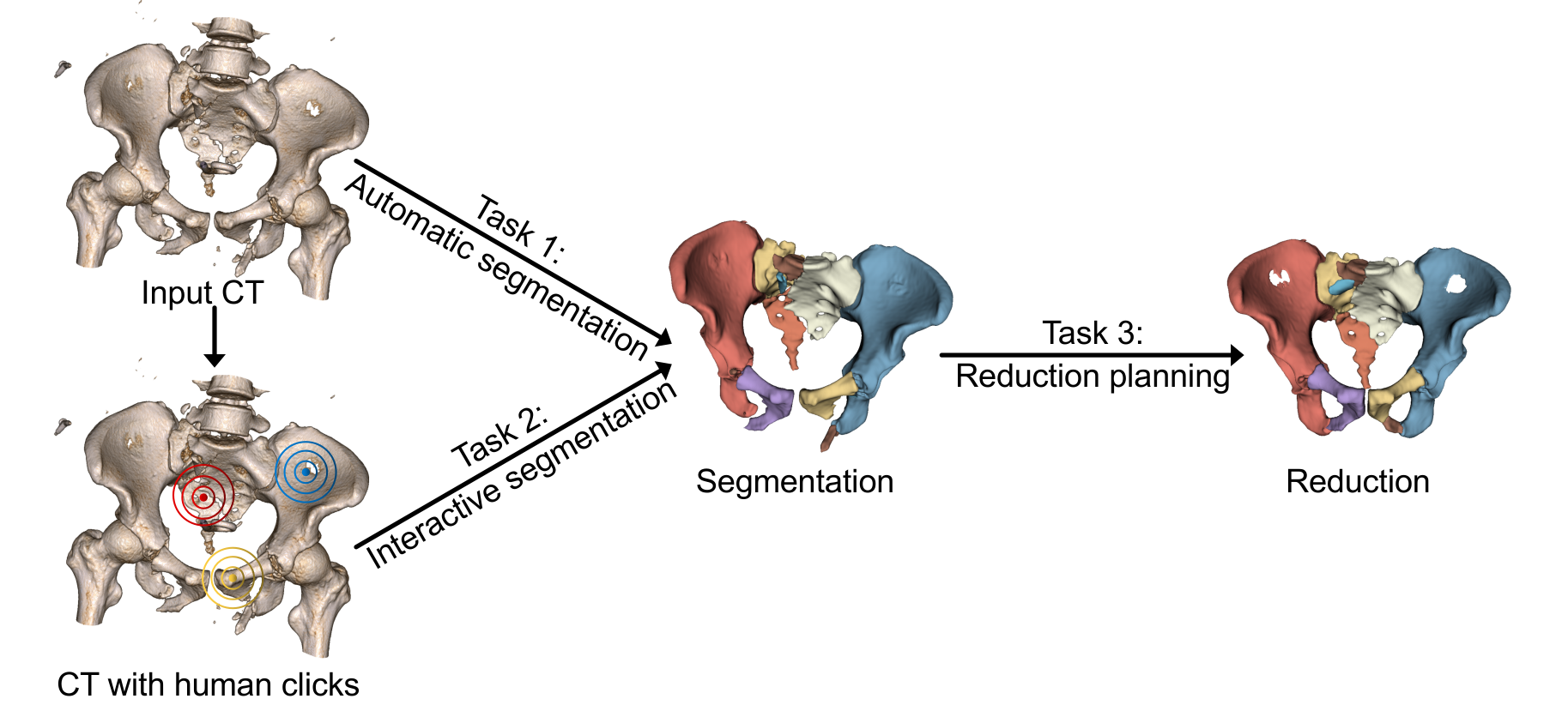
Task 1: PENGWIN-Auto: Automatic Peripelvic Fracture Segmentation
Task 2: PENGWIN-Interact: Interactive Peripelvic Fracture Segmentation
Task 3: PENGWIN-Reduction: Peripelvic Fracture Reduction Planning