
Schedule
MICCAI 2026 SATELLITE EVENT - PENGWIN
Time: 08:00 - 12:30, Sunday, September 27, 2026
Location: Auditorium Cassin (Floor G), Strasbourg Convention Center, FRANCE
Remote participation: Zoom Meeting ID: 622 076 1747; Passcode: PENGWIN26
Join Zoom Meeting: https://us06web.zoom.us/j/6220761747?pwd=CnhVabYqRjzZfbTiyQL5STwGGmZgzA.1&omn=81528058789
📌 News
- ✅ [Apr 24] The training sets for all tasks have been released.
- ✅ [May 20] The baseline code for Task 1, Task 2 and Task 3 has been released.
- ✅ [May 22] Preliminary phase submissions for all tasks are now open.
- ✅ [Jul 20] Final test phase submissions for Task 3 are now open.
- ✅ [Jul 30] Final test phase submissions for all tasks are now open.
- ✅ [Aug 6] The algorithm submission deadline is Aug 19 23:59 AoE (UTC−12), and the deadline for the mandatory method description is Aug 22. No extensions will be granted.
- ✅ [Aug 20] Task 2 Evaluation Note: Current evaluations for Task 2 are based on a subset of the test data to allow participants to quickly see if their approaches work without errors. All successful submissions will be re-evaluated on the full test set after the deadline.
🎉 [Sep 2] Final Results have been announced, and the full final task 2 leaderboards have now been published. Congratulations to all participants!
🐧 [Sep 3] The MICCAI Conference Session Schedule have been announced. We would be very happy to have all particpants join the discussion, either in person or online. Please feel free to share the event information and schedule with others who may be interested.
🐧 Background
Peripelvic fractures, primarily caused by high-energy trauma, are among the most severe injuries, with a disability rate exceeding 50% and a mortality rate over 13%. These injuries are the deadliest among complex fractures, presenting significant challenges for surgical intervention due to the intricate anatomy of the pelvis and surrounding soft tissues. Accurate segmentation of peripelvic injuries in 3D CT scans is essential for effective trauma diagnosis and image-guided surgical planning. High-quality segmentation directly influences critical tasks such as fracture classification, preoperative reduction planning, and screw fixation, ultimately improving surgical outcomes and patient care. This evolution reflects the actual requirements of modern digital orthopedics by transitioning from merely "seeing" the fracture to "solving" the mechanical restoration.
📋 Tasks
As a MICCAI 2026 satellite event, PENGWIN 2026 significantly expands the clinical scale and introduces a comprehensive 3D workflow including interactive segmentation and fracture reduction planning. Our dataset has been significantly expanded to include CT scans from 500 clinical cases scheduled for peripelvic reduction surgery, collected from seven institutions using various scanning devices. To support the training of data-driven reduction models, we additionally provide 16,000 simulated fracture cases generated from 400 healthy peripelvic CTs using advanced fracture simulation algorithms. To ensure accurate performance evaluation, multiple orthopedic medical experts conducted comprehensive annotations and cross-checks on the training, validation, and testing datasets.
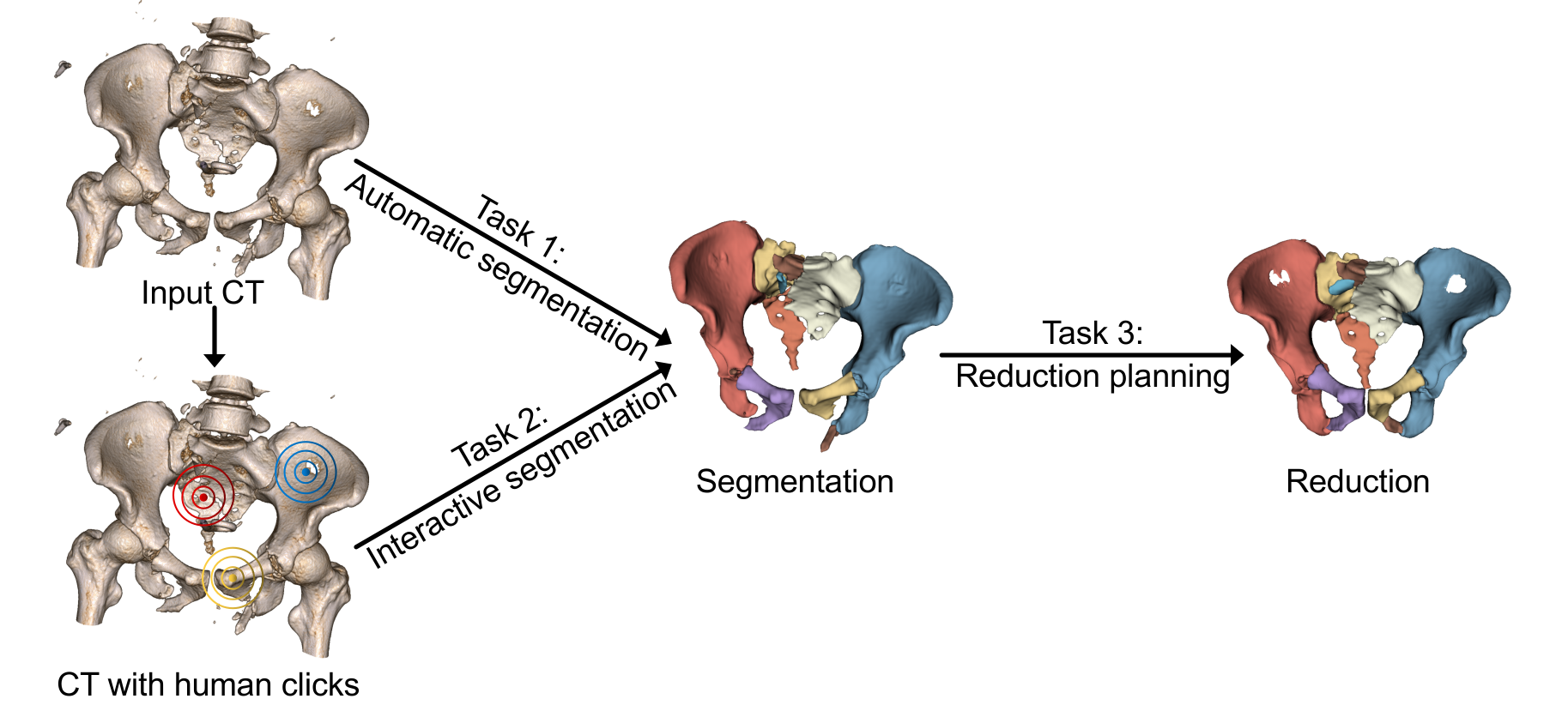
Task 1: PENGWIN-Auto: Automatic Peripelvic Fracture Segmentation
Task 2: PENGWIN-Interact: Interactive Peripelvic Fracture Segmentation
Task 3: PENGWIN-Reduction: Peripelvic Fracture Reduction Planning
📎 Citation
% 2024 challenge summary paper (early access)
@article{TMIPENGWIN,
  author={Sang, Yudi and Liu, Yanzhen and Yibulayimu, Sutuke and Wang, Yunning and Killeen, Benjamin D. and Liu, Mingxu and Ku, Ping-Cheng and Johannsen, Ole and Gotkowski, Karol and Zenk, Maximilian and Maier-Hein, Klaus and Isensee, Fabian and Yue, Peiyan and Wang, Yi and Yu, Haidong and Pan, Zhaohong and He, Yutong and Liang, Xiaokun and Liu, Daiqi and Fan, Fuxin and Jurgas, Artur and Skalski, Andrzej and Ma, Yuxi and Yang, Jing and Płotka, Szymon and Litka, Rafał and Zhu, Gang and Song, Yingchun and Unberath, Mathias and Armand, Mehran and Ruan, Dan and Kevin Zhou, S. and Cao, Qiyong and Zhao, Chunpeng and Wu, Xinbao and Wang, Yu},
  journal={IEEE Transactions on Medical Imaging},
  title={Benchmark of Segmentation Techniques for Pelvic Fracture in CT and X-Ray: Summary of the PENGWIN 2024 Challenge},
  year={2026},
  volume={45},
  number={5},
  pages={2212-2228},
  doi={10.1109/TMI.2025.3650126}
}

% benchmark method
@article{LIUandYIBULAYIMU2025MEDIA,
  title = {Preoperative fracture reduction planning for image-guided pelvic trauma surgery: A comprehensive pipeline with learning},
  journal = {Medical Image Analysis},
  volume = {102},
  pages = {103506},
  year = {2025},
  issn = {1361-8415},
  doi = {https://doi.org/10.1016/j.media.2025.103506},
  url = {https://www.sciencedirect.com/science/article/pii/S1361841525000544},
  author = {Yanzhen Liu and Sutuke Yibulayimu and Yudi Sang and Gang Zhu and Chao Shi and Chendi Liang and Qiyong Cao and Chunpeng Zhao and Xinbao Wu and Yu Wang},
}

% benchmark method (reduction planning)
@article{yibulayimu2025fracformer,
  author={Yibulayimu, Sutuke and Liu, Yanzhen and Sang, Yudi and Qin, Jingjiang and Shi, Chao and Liang, Chendi and Zhu, Gang and Wang, Yu and Zhao, Chunpeng and Wu, Xinbao},
  journal={IEEE Transactions on Medical Imaging},
  title={FracFormer: Fracture Reduction Planning With Transformer-Based Shape Restoration and Fracture Data Simulation},
  year={2025},
  volume={44},
  number={8},
  pages={3270-3283},
  doi={10.1109/TMI.2025.3561030}
}